2012-06-27

2D Interpolation, Part 3: Linear Array Accesses

Last time I've hoisted all accesses to the source array. This opens the door to being able to process linear arrays representing a matrix in row-major order by stenciling. Not only that, but I was able to completely eliminate the need to have a bordered array on input by explicitly replicating elements as needed. The first step is to use a row buffer into which to copy the elements to be processed. Instead of stenciling by indexing into the source array, I'll index into this row buffer. The code is identical to the one presented last time, except for the initialization, done by copying, and the indexing. Instead of four arrays p0, p1, p2 and p3 I use just one containing four rows back to front; this requires computing the indices by hand. To bring in the next row to interpolate, a pair of arrayCopys make room in the row buffer and assign the new row in the opened space. Now both yi and xi cease to represent the index of the stencil over the source array, and I'm free to simplify the index arithmetic by offsetting their starting values:

void interp0() {
  final float[] p = new float[4 * nx];
  for (int i = 0; i < 4; i++)
    arrayCopy(data[i], 0, p, i*nx, nx);
  int yr = 0;
  int yi = 3;
  int offset = 0;
  for (int i = 0; i < height; i++) {
    final float yf = (float) yr / (float) height;
    float c00 = p[0*nx+0], c01 = p[0*nx+1], c02 = p[0*nx+2], c03 = p[0*nx+3];
    float c10 = p[1*nx+0], c11 = p[1*nx+1], c12 = p[1*nx+2], c13 = p[1*nx+3];
    float c20 = p[2*nx+0], c21 = p[2*nx+1], c22 = p[2*nx+2], c23 = p[2*nx+3];
    float c30 = p[3*nx+0], c31 = p[3*nx+1], c32 = p[3*nx+2], c33 = p[3*nx+3];
    int xr = 0;
    int xi = 3;
    for (int j = 0; j < width; j++) {
      final float xf = (float) xr / (float) width;
      float c = 0;
      switch (method) {
      case NEAREST:
        c = yf < 0.5 ? xf < 0.5 ? c11 : c12 : xf < 0.5 ? c21 : c22;
        break;
      case BILINEAR:
        c = linear(yf,
            linear(xf, c11, c12),
            linear(xf, c21, c22) );
        break;
      case BICUBIC:
        c = cubic(yf,
            cubic(xf, c00, c01, c02, c03),
            cubic(xf, c10, c11, c12, c13),
            cubic(xf, c20, c21, c22, c23),
            cubic(xf, c30, c31, c32, c33) );
        break;
      }
      pixels[offset++] = hue(c);
      xr += nx - 3;
      if (xr >= width) {
        xr -= width;
        xi += 1;
        if (xi < nx) {
          c00 = c01; c01 = c02; c02 = c03; c03 = p[0*nx+xi];
          c10 = c11; c11 = c12; c12 = c13; c13 = p[1*nx+xi];
          c20 = c21; c21 = c22; c22 = c23; c23 = p[2*nx+xi];
          c30 = c31; c31 = c32; c32 = c33; c33 = p[3*nx+xi];
        }
      }
    }
    yr += ny - 3;
    if (yr >= height) {
      yr -= height;
      yi += 1;
      if (yi < ny) {
        arrayCopy(p, nx, p, 0, 3*nx);
        arrayCopy(data[yi], 0, p, 3*nx, nx);
      }
    }
  }
}

Processing a matrix as a linear array in row-major order is a matter of adjusting the sources to the arrayCopys. I've renamed the source array as srcpix and its dimensions as nrows and ncols so that later I can modify the code to avoid the need for an explicit border without breaking the existing interp1():

final float[] srcpix = {
  0.60, 0.60, 0.48, 0.24, 0.60, 0.60,
  0.60, 0.60, 0.48, 0.24, 0.60, 0.60,
  0.00, 0.00, 0.36, 0.12, 0.48, 0.48,
  0.24, 0.24, 0.48, 0.60, 0.12, 0.12,
  0.12, 0.12, 0.24, 0.48, 0.36, 0.36,
  0.12, 0.12, 0.24, 0.48, 0.36, 0.36
};
final int nrows = 6;
final int ncols = 6;

void interp0() {
  final float[] p = new float[4 * ncols];
  arrayCopy(srcpix, 0, p, 0, 4 * ncols);
  int yr = 0;
  int yi = 3;
  int offset = 0;
  for (int i = 0; i < height; i++) {
    final float yf = (float) yr / (float) height;
    float c00 = p[0*ncols+0], c01 = p[0*ncols+1], c02 = p[0*ncols+2], c03 = p[0*ncols+3];
    float c10 = p[1*ncols+0], c11 = p[1*ncols+1], c12 = p[1*ncols+2], c13 = p[1*ncols+3];
    float c20 = p[2*ncols+0], c21 = p[2*ncols+1], c22 = p[2*ncols+2], c23 = p[2*ncols+3];
    float c30 = p[3*ncols+0], c31 = p[3*ncols+1], c32 = p[3*ncols+2], c33 = p[3*ncols+3];
    int xr = 0;
    int xi = 3;
    for (int j = 0; j < width; j++) {
      final float xf = (float) xr / (float) width;
      float c = 0;
      switch (method) {
      case NEAREST:
        c = yf < 0.5 ? xf < 0.5 ? c11 : c12 : xf < 0.5 ? c21 : c22;
        break;
      case BILINEAR:
        c = linear(yf,
            linear(xf, c11, c12),
            linear(xf, c21, c22) );
        break;
      case BICUBIC:
        c = cubic(yf,
            cubic(xf, c00, c01, c02, c03),
            cubic(xf, c10, c11, c12, c13),
            cubic(xf, c20, c21, c22, c23),
            cubic(xf, c30, c31, c32, c33) );
        break;
      }
      pixels[offset++] = hue(c);
      xr += ncols - 3;
      if (xr >= width) {
        xr -= width;
        xi += 1;
        if (xi < ncols) {
          c00 = c01; c01 = c02; c02 = c03; c03 = p[0*ncols+xi];
          c10 = c11; c11 = c12; c12 = c13; c13 = p[1*ncols+xi];
          c20 = c21; c21 = c22; c22 = c23; c23 = p[2*ncols+xi];
          c30 = c31; c31 = c32; c32 = c33; c33 = p[3*ncols+xi];
        }
      }
    }
    yr += nrows - 3;
    if (yr >= height) {
      yr -= height;
      yi += 1;
      if (yi < nrows) {
        arrayCopy(p, ncols, p, 0, 3*ncols);
        arrayCopy(srcpix, yi*ncols, p, 3*ncols, ncols);
      }
    }
  }
}

Now in a slow-motion approach towards eliminating the repeated border, I'll first reduce the array dimensions to their true value. In the preceding code I substitute nrows := nrows−2 and ncols := ncols−2, and simplify all indices:

final int nrows = 4;
final int ncols = 4;

void interp0() {
  final float[] p = new float[4*(ncols+2)];
  arrayCopy(srcpix, 0, p, 0, 4*(ncols+2));
  int yr = 0;
  int yi = 3;
  int offset = 0;
  for (int i = 0; i < height; i++) {
    final float yf = (float) yr / (float) height;
    float c00 = p[0*ncols+0], c01 = p[0*ncols+1], c02 = p[0*ncols+2], c03 = p[0*ncols+3];
    float c10 = p[1*ncols+2], c11 = p[1*ncols+3], c12 = p[1*ncols+4], c13 = p[1*ncols+5];
    float c20 = p[2*ncols+4], c21 = p[2*ncols+5], c22 = p[2*ncols+6], c23 = p[2*ncols+7];
    float c30 = p[3*ncols+6], c31 = p[3*ncols+7], c32 = p[3*ncols+8], c33 = p[3*ncols+9];
    int xr = 0;
    int xi = 3;
    for (int j = 0; j < width; j++) {
      final float xf = (float) xr / (float) width;
      float c = 0;
      switch (method) {
      case NEAREST:
        c = yf < 0.5 ? xf < 0.5 ? c11 : c12 : xf < 0.5 ? c21 : c22;
        break;
      case BILINEAR:
        c = linear(yf,
            linear(xf, c11, c12),
            linear(xf, c21, c22) );
        break;
      case BICUBIC:
        c = cubic(yf,
            cubic(xf, c00, c01, c02, c03),
            cubic(xf, c10, c11, c12, c13),
            cubic(xf, c20, c21, c22, c23),
            cubic(xf, c30, c31, c32, c33) );
        break;
      }
      pixels[offset++] = hue(c);
      xr += ncols - 1;
      if (xr >= width) {
        xr -= width;
        xi += 1;
        if (xi < ncols+2) {
          c00 = c01; c01 = c02; c02 = c03; c03 = p[0*ncols+xi+0];
          c10 = c11; c11 = c12; c12 = c13; c13 = p[1*ncols+xi+2];
          c20 = c21; c21 = c22; c22 = c23; c23 = p[2*ncols+xi+4];
          c30 = c31; c31 = c32; c32 = c33; c33 = p[3*ncols+xi+6];
        }
      }
    }
    yr += nrows - 1;
    if (yr >= height) {
      yr -= height;
      yi += 1;
      if (yi < nrows+2) {
        arrayCopy(p, (ncols+2), p, 0, 3*(ncols+2));
        arrayCopy(srcpix, yi*(ncols+2), p, 3*ncols+6, ncols+2);
      }
    }
  }
}

In the second part of the slo-mo maneuver, I'll eliminate the repeated values from the source matrix. Every row repeats the first and last element, and both the first and the last rows are repeated in turn. I achieve this by careful stuffing into the row buffer:

final float[] srcpix = {
0.60, 0.48, 0.24, 0.60,
0.00, 0.36, 0.12, 0.48,
0.24, 0.48, 0.60, 0.12,
0.12, 0.24, 0.48, 0.36,
};
final int nrows = 4;
final int ncols = 4;

void interp0() {
  final float[] p = new float[4*ncols+8];
  p[1*ncols+2] = srcpix[0*ncols]; arrayCopy(srcpix, 0*ncols, p, 1*ncols+3, ncols); p[2*ncols+3] = srcpix[1*ncols-1];
  p[2*ncols+4] = srcpix[1*ncols]; arrayCopy(srcpix, 1*ncols, p, 2*ncols+5, ncols); p[3*ncols+5] = srcpix[2*ncols-1];
  p[3*ncols+6] = srcpix[2*ncols]; arrayCopy(srcpix, 2*ncols, p, 3*ncols+7, ncols); p[4*ncols+7] = srcpix[3*ncols-1];
  arrayCopy(p, 1*ncols+2, p, 0, ncols+2);
  int yr = 0;
  int yi = 2;
  int offset = 0;
  for (int i = 0; i < height; i++) {
    final float yf = (float) yr / (float) height;
    float c00 = p[0*ncols+0], c01 = p[0*ncols+1], c02 = p[0*ncols+2], c03 = p[0*ncols+3];
    float c10 = p[1*ncols+2], c11 = p[1*ncols+3], c12 = p[1*ncols+4], c13 = p[1*ncols+5];
    float c20 = p[2*ncols+4], c21 = p[2*ncols+5], c22 = p[2*ncols+6], c23 = p[2*ncols+7];
    float c30 = p[3*ncols+6], c31 = p[3*ncols+7], c32 = p[3*ncols+8], c33 = p[3*ncols+9];
    int xr = 0;
    int xi = 3;
    for (int j = 0; j < width; j++) {
      final float xf = (float) xr / (float) width;
      float c = 0;
      switch (method) {
      case NEAREST:
        c = yf < 0.5 ? xf < 0.5 ? c11 : c12 : xf < 0.5 ? c21 : c22;
        break;
      case BILINEAR:
        c = linear(yf,
            linear(xf, c11, c12),
            linear(xf, c21, c22) );
        break;
      case BICUBIC:
        c = cubic(yf,
            cubic(xf, c00, c01, c02, c03),
            cubic(xf, c10, c11, c12, c13),
            cubic(xf, c20, c21, c22, c23),
            cubic(xf, c30, c31, c32, c33) );
        break;
      }
      pixels[offset++] = hue(c);
      xr += ncols - 1;
      if (xr >= width) {
        xr -= width;
        xi += 1;
        if (xi < ncols+2) {
          c00 = c01; c01 = c02; c02 = c03; c03 = p[0*ncols+xi+0];
          c10 = c11; c11 = c12; c12 = c13; c13 = p[1*ncols+xi+2];
          c20 = c21; c21 = c22; c22 = c23; c23 = p[2*ncols+xi+4];
          c30 = c31; c31 = c32; c32 = c33; c33 = p[3*ncols+xi+6];
        }
      }
    }
    yr += nrows - 1;
    if (yr >= height) {
      yr -= height;
      yi += 1;
      if (yi <= nrows) {
        arrayCopy(p, (ncols+2), p, 0, 3*(ncols+2));
        if (yi < nrows) {
          p[3*ncols+6] = srcpix[yi*ncols];
          arrayCopy(srcpix, yi*ncols, p, 3*ncols+7, ncols);
          p[4*ncols+7] = srcpix[(yi+1)*ncols-1];
        }
      }
    }
  }
}

Note that during initialization the first row is duplicated by an explicit copy. Note also that the inner loop doesn't change at all. The outer loop does; since the first duplicated row was eliminated, yi initially is 2, not 3; since the last duplicated row was eliminated, there new bounds for yi is nrows, not nrows + 2, and the conditions simplify accordingly. Since the last row is repeated, it must be processed even when yi is exactly nrows. Finally, since the new row must repeat its first and last elements, I must use the same schema as for the initialization. In the case of the repeated last row, the first arrayCopy moves the three last rows to the front; by doing nothing the very last row appears in the last two consecutive strides of the row buffer.

Believe it or not, I consider this code rather compact. Normally, the special case of repeated elements is handled by unrolling the loops and placing a loop header and a loop footer specialized to the appropriate values. By using the row buffer, I can avoid duplicating code, for a cost in O(N) storage. As it is, the only transformation required would be to extract the switch from the inner loop into separate the interpolators and simplify the nearest-neighbor and bilinear cases by eliminating the unneeded elements. Before doing that, it would be best to tackle the problem of processing ARGB sources, by unpacking the channels in the source pixels, interpolating each and repacking them into a destination pixel. That can be done neatly with the row buffers for maximal inner-loop speed. Until the next time!

2012-06-26

2D Interpolation, Part 2: Minimizing Array Accesses

Last time I massaged the interpolator to avoid computing every time the linear transformation from destination space to source space, using only integer variables. With that rewriting, it is time to avoid referencing source values more than is needed. First thing we do, let's name all elements:

void interp0() {
  int offset = 0;
  int yn = 0;
  int yi = 1;
  for (int i = 0; i < height; i++) {
    final float yr = (float) yn / (float) height;
    int xn = 0;
    int xi = 1;
    for (int j = 0; j < width; j++) {
      final float xr = (float) xn / (float) width;
      float c00 = data[yi-1][xi-1], c01 = data[yi-1][xi+0], c02 = data[yi-1][xi+1], c03 = data[yi-1][xi+2];
      float c10 = data[yi+0][xi-1], c11 = data[yi+0][xi+0], c12 = data[yi+0][xi+1], c13 = data[yi+0][xi+2];
      float c20 = data[yi+1][xi-1], c21 = data[yi+1][xi+0], c22 = data[yi+1][xi+1], c23 = data[yi+1][xi+2];
      float c30 = data[yi+2][xi-1], c31 = data[yi+2][xi+0], c32 = data[yi+2][xi+1], c33 = data[yi+2][xi+2];
      float c = 0;
      switch (method) {
      case NEAREST:
        c = yr < 0.5 ? xr < 0.5 ? c11 : c12 : xr < 0.5 ? c21 : c22;
        break;
      case BILINEAR:
        c = linear(yr,
            linear(xr, c11, c12),
            linear(xr, c21, c22) );
        break;
      case BICUBIC:
        c = cubic(yr,
            cubic(xr, c00, c01, c02, c03),
            cubic(xr, c10, c11, c12, c13),
            cubic(xr, c20, c21, c22, c23),
            cubic(xr, c30, c31, c32, c33) );
        break;
      }
      pixels[offset++] = hue(c);
      xn += nx - 3;
      if (xn >= width) {
        xn -= width;
        xi += 1;
      }
    }
    yn += ny - 3;
    if (yn >= height) {
      yn -= height;
      yi += 1;
    }
  }
}

Two things are of note: first, I need all 16 elements for bicubic interpolation, even if nearest-neighbor or bilinear were requested. Second, in the nearest-neighbor case I had to transform an index computation involving a float-to-integer rounding into explicit conditionals. Such is the price of progress.

Since yi, xi don't change at each step, it is possible to just reference new elements when they do, and reuse values in the mean time. First I will reuse the columns. In order to do that I need to hoist the assignments outside the inner loop, in effect converting them to pure initializations, and arrange for the variables to update when xi is incremented:

void interp0() {
  int offset = 0;
  int yn = 0;
  int yi = 1;
  for (int i = 0; i < height; i++) {
    final float yr = (float) yn / (float) height;
    int xn = 0;
    int xi = 1;
    float c00 = data[yi-1][0], c01 = data[yi-1][1], c02 = data[yi-1][2], c03 = data[yi-1][3];
    float c10 = data[yi+0][0], c11 = data[yi+0][1], c12 = data[yi+0][2], c13 = data[yi+0][3];
    float c20 = data[yi+1][0], c21 = data[yi+1][1], c22 = data[yi+1][2], c23 = data[yi+1][3];
    float c30 = data[yi+2][0], c31 = data[yi+2][1], c32 = data[yi+2][2], c33 = data[yi+2][3];
    for (int j = 0; j < width; j++) {
      final float xr = (float) xn / (float) width;
      float c = 0;
      switch (method) {
      case NEAREST:
        c = yr < 0.5 ? xr < 0.5 ? c11 : c12 : xr < 0.5 ? c21 : c22;
        break;
      case BILINEAR:
        c = linear(yr,
            linear(xr, c11, c12),
            linear(xr, c21, c22) );
        break;
      case BICUBIC:
        c = cubic(yr,
            cubic(xr, c00, c01, c02, c03),
            cubic(xr, c10, c11, c12, c13),
            cubic(xr, c20, c21, c22, c23),
            cubic(xr, c30, c31, c32, c33) );
        break;
      }
      pixels[offset++] = hue(c);
      xn += nx - 3;
      if (xn >= width) {
        xn -= width;
        xi += 1;
        if (xi < nx - 2) {
          c00 = c01; c01 = c02; c02 = c03; c03 = data[yi-1][xi+2];
          c10 = c11; c11 = c12; c12 = c13; c13 = data[yi+0][xi+2];
          c20 = c21; c21 = c22; c22 = c23; c23 = data[yi+1][xi+2];
          c30 = c31; c31 = c32; c32 = c33; c33 = data[yi+2][xi+2];
        }
      }
    }
    yn += ny - 3;
    if (yn >= height) {
      yn -= height;
      yi += 1;
    }
  }
}

The initialization inlines the constant value xi = 1 in the second index. The update shifts the values around in classic bucket brigade fashion, and fetches fresh values for the new column to process. Note that there is a subtlety involving the range check, in that the last iteration for j will have xi = nx−2, but at that point it is too early to notice: logically the loop termination test should come before updating xn, xi and the array elements. I opt here to conditionalize the update to keep the for loop structured; feel free to break out of the loop instead.

Now it's time to reuse the rows. This is made simpler by the fact that the source matrix is an array of arrays. First I introduce row variables pointing to each active row, and rename the element accesses accordingly:

void interp0() {
  int offset = 0;
  int yn = 0;
  int yi = 1;
  for (int i = 0; i < height; i++) {
    final float yr = (float) yn / (float) height;
    int xn = 0;
    int xi = 1;
    float[] p0 = data[yi-1], p1 = data[yi+0], p2 = data[yi+1], p3 = data[yi+2];
    float c00 = p0[0], c01 = p0[1], c02 = p0[2], c03 = p0[3];
    float c10 = p1[0], c11 = p1[1], c12 = p1[2], c13 = p1[3];
    float c20 = p2[0], c21 = p2[1], c22 = p2[2], c23 = p2[3];
    float c30 = p3[0], c31 = p3[1], c32 = p3[2], c33 = p3[3];
    for (int j = 0; j < width; j++) {
      final float xr = (float) xn / (float) width;
      float c = 0;
      switch (method) {
      case NEAREST:
        c = yr < 0.5 ? xr < 0.5 ? c11 : c12 : xr < 0.5 ? c21 : c22;
        break;
      case BILINEAR:
        c = linear(yr,
            linear(xr, c11, c12),
            linear(xr, c21, c22) );
        break;
      case BICUBIC:
        c = cubic(yr,
            cubic(xr, c00, c01, c02, c03),
            cubic(xr, c10, c11, c12, c13),
            cubic(xr, c20, c21, c22, c23),
            cubic(xr, c30, c31, c32, c33) );
        break;
      }
      pixels[offset++] = hue(c);
      xn += nx - 3;
      if (xn >= width) {
        xn -= width;
        xi += 1;
        if (xi < nx - 2) {
          c00 = c01; c01 = c02; c02 = c03; c03 = p0[xi+2];
          c10 = c11; c11 = c12; c12 = c13; c13 = p1[xi+2];
          c20 = c21; c21 = c22; c22 = c23; c23 = p2[xi+2];
          c30 = c31; c31 = c32; c32 = c33; c33 = p3[xi+2];
        }
      }
    }
    yn += ny - 3;
    if (yn >= height) {
      yn -= height;
      yi += 1;
    }
  }
}

Next I hoist the row assignments out of the outer loop, as I did before:

void interp0() {
  float[] p0 = data[0], p1 = data[1], p2 = data[2], p3 = data[3];
  int yn = 0;
  int yi = 1;
  int offset = 0;
  for (int i = 0; i < height; i++) {
    final float yr = (float) yn / (float) height;
    float c00 = p0[0], c01 = p0[1], c02 = p0[2], c03 = p0[3];
    float c10 = p1[0], c11 = p1[1], c12 = p1[2], c13 = p1[3];
    float c20 = p2[0], c21 = p2[1], c22 = p2[2], c23 = p2[3];
    float c30 = p3[0], c31 = p3[1], c32 = p3[2], c33 = p3[3];
    int xn = 0;
    int xi = 1;
    for (int j = 0; j < width; j++) {
      final float xr = (float) xn / (float) width;
      float c = 0;
      switch (method) {
      case NEAREST:
        c = yr < 0.5 ? xr < 0.5 ? c11 : c12 : xr < 0.5 ? c21 : c22;
        break;
      case BILINEAR:
        c = linear(yr,
            linear(xr, c11, c12),
            linear(xr, c21, c22) );
        break;
      case BICUBIC:
        c = cubic(yr,
            cubic(xr, c00, c01, c02, c03),
            cubic(xr, c10, c11, c12, c13),
            cubic(xr, c20, c21, c22, c23),
            cubic(xr, c30, c31, c32, c33) );
        break;
      }
      pixels[offset++] = hue(c);
      xn += nx - 3;
      if (xn >= width) {
        xn -= width;
        xi += 1;
        if (xi < nx - 2) {
          c00 = c01; c01 = c02; c02 = c03; c03 = p0[xi+2];
          c10 = c11; c11 = c12; c12 = c13; c13 = p1[xi+2];
          c20 = c21; c21 = c22; c22 = c23; c23 = p2[xi+2];
          c30 = c31; c31 = c32; c32 = c33; c33 = p3[xi+2];
        }
      }
    }
    yn += ny - 3;
    if (yn >= height) {
      yn -= height;
      yi += 1;
      if (yi < ny - 2) {
        p0 = p1; p1 = p2; p2 = p3; p3 = data[yi+2];
      }
    }
  }
}

Here I'm presented with exactly the same situation regarding the last iteration as with the columns, and faced with the same choice. At this point I could call it quits and be satisfied with a reasonable implementation; I'll press further. Next time I'll convert the interpolator to operate on a linear array, opening the door to manipulating graphics directly.

2012-06-25

2D Interpolation, Part 1: The Digital Differential Analyzer

To my Planet OCaml readers, I apologize for veering into Java. I've been playing with Processing of lately, because it's far easier to prototype silly, simple animations (fractals! Fractals everywhere!) in it than by using OCamlSDL, say. Last time I showed a basic 2D interpolator; now it's time to start massaging it into shape. Let's recall the original code:

void interp0() {
  final float dy = (float) (ny - 3) / height;
  final float dx = (float) (nx - 3) / width;
  int offset = 0;
  for (int i = 0; i < height; i++) {
    float yr = 1 + dy * i;
    int yi = (int) yr;
    yr -= yi;
    for (int j = 0; j < width; j++) {
      float xr = 1 + dx * j;
      int xi = (int) xr;
      xr -= xi;
      float c = 0;
      switch (method) {
      case NEAREST:
        c = data[yi + (int) (yr + 0.5)][xi + (int) (xr + 0.5)];
        break;
      case BILINEAR:
        c = linear(yr,
            linear(xr, data[yi+0][xi+0], data[yi+0][xi+1]),
            linear(xr, data[yi+1][xi+0], data[yi+1][xi+1]) );
        break;
      case BICUBIC:
        c = cubic(yr,
            cubic(xr, data[yi-1][xi-1], data[yi-1][xi+0], data[yi-1][xi+1], data[yi-1][xi+2]),
            cubic(xr, data[yi+0][xi-1], data[yi+0][xi+0], data[yi+0][xi+1], data[yi+0][xi+2]),
            cubic(xr, data[yi+1][xi-1], data[yi+1][xi+0], data[yi+1][xi+1], data[yi+1][xi+2]),
            cubic(xr, data[yi+2][xi-1], data[yi+2][xi+0], data[yi+2][xi+1], data[yi+2][xi+2]) );
        break;
      }
      pixels[offset++] = hue(c);
    }
  }
}

The coordinate transformations from destination array to source matrix involve a linear transformation s = s0 + k·(d - d0), where k is a floating-point approximation to a rational number. This can be done using the all-integer Digital Differential Analyzer or DDA. First of all, note that there's no reason for yr, xr to start at 1; only yi, xi need to be offset:

void interp0() {
  final float dy = (float) (ny - 3) / height;
  final float dx = (float) (nx - 3) / width;
  int offset = 0;
  for (int i = 0; i < height; i++) {
    float yr = dy * i;
    int yi = (int) yr;
    yr -= yi;
    yi += 1;
    for (int j = 0; j < width; j++) {
      float xr = dx * j;
      int xi = (int) xr;
      xr -= xi;
      xi += 1;
      float c = 0;
      switch (method) {
      case NEAREST:
        c = data[yi + (int) (yr + 0.5)][xi + (int) (xr + 0.5)];
        break;
      case BILINEAR:
        c = linear(yr,
            linear(xr, data[yi+0][xi+0], data[yi+0][xi+1]),
            linear(xr, data[yi+1][xi+0], data[yi+1][xi+1]) );
        break;
      case BICUBIC:
        c = cubic(yr,
            cubic(xr, data[yi-1][xi-1], data[yi-1][xi+0], data[yi-1][xi+1], data[yi-1][xi+2]),
            cubic(xr, data[yi+0][xi-1], data[yi+0][xi+0], data[yi+0][xi+1], data[yi+0][xi+2]),
            cubic(xr, data[yi+1][xi-1], data[yi+1][xi+0], data[yi+1][xi+1], data[yi+1][xi+2]),
            cubic(xr, data[yi+2][xi-1], data[yi+2][xi+0], data[yi+2][xi+1], data[yi+2][xi+2]) );
        break;
      }
      pixels[offset++] = hue(c);
    }
  }
}

At this point you will notice error pixels along some contours. Those are the pixels for which the floating-point quotient (ny−3)/height, resp. (nx−3)/width is not exactly representable, and shifting the floating point values by one makes the error manifest.

Variables yr, xr could start at 0 and be incremented by dy, dx respectively, at the end of the corresponding loop. This is the essence of the DDA. Unfortunately this would accumulate the error inherent in computing dy and dx very quickly.

Introduce a variable yn = yr·height so that yr = yn/height. Every time yr is incremented by dy = (ny−3)/height, yn is incremented by ny−3 which is an integer. Now yi is the integer part of yr, which is to say the integer part of yn/height. This means that yi will increase whenever yn ≥ height; we can keep track of the quotient of i·(ny−3) by height in yi and let yn be the remainder, adjusting it at each step.

Exactly the same reasoning applies to xr and xi by introducing an integer variable xn representing the remainder of j·(nx−3) when divided by width. Making both changes results in yr, xr being simple constants:

void interp0() {
  int offset = 0;
  int yn = 0;
  int yi = 1;
  for (int i = 0; i < height; i++) {
    final float yr = (float) yn / (float) height;
    int xn = 0;
    int xi = 1;
    for (int j = 0; j < width; j++) {
      final float xr = (float) xn / (float) width;
      float c = 0;
      switch (method) {
      case NEAREST:
        c = data[yi + (int) (yr + 0.5)][xi + (int) (xr + 0.5)];
        break;
      case BILINEAR:
        c = linear(yr,
            linear(xr, data[yi+0][xi+0], data[yi+0][xi+1]),
            linear(xr, data[yi+1][xi+0], data[yi+1][xi+1]) );
        break;
      case BICUBIC:
        c = cubic(yr,
            cubic(xr, data[yi-1][xi-1], data[yi-1][xi+0], data[yi-1][xi+1], data[yi-1][xi+2]),
            cubic(xr, data[yi+0][xi-1], data[yi+0][xi+0], data[yi+0][xi+1], data[yi+0][xi+2]),
            cubic(xr, data[yi+1][xi-1], data[yi+1][xi+0], data[yi+1][xi+1], data[yi+1][xi+2]),
            cubic(xr, data[yi+2][xi-1], data[yi+2][xi+0], data[yi+2][xi+1], data[yi+2][xi+2]) );
        break;
      }
      pixels[offset++] = hue(c);
      xn += nx - 3;
      if (xn >= width) {
        xn -= width;
        xi += 1;
      }
    }
    yn += ny - 3;
    if (yn >= height) {
      yn -= height;
      yi += 1;
    }
  }
}

Next time I'll show how to put the array accesses on a diet.

2012-06-22

2D Interpolation, Part 0: The Groundwork

(First of a series) My process for going from a textbook implementation of an algorithm to an efficient production-grade version of it is to methodically apply meaning-preserving transformations that make the code progressively tighter. In this case I'll massage a naïve 2D interpolator that selectively uses nearest-neighbor, bilinear and bicubic interpolation. I started by studying a basic explanation and completed it with the specifics related to bicubic interpolation. Since this is a graphics application, I define meaning-preserving as "agrees on (almost) all pixels", and I carry the test by visual inspection. I use a straight Processing 2 sketch without any complications or embellishments.

To begin with my source data will be a simple 4×4 matrix of floats in the form of an array of arrays with elements repeated around the border. This is not only suboptimal on any number of accounts, it doesn't accomodate the overwhelmingly usual case of image stretching; but for now it is sufficient:

final float[][] data = {
  { 0.60, 0.60, 0.48, 0.24, 0.60, 0.60 },
  { 0.60, 0.60, 0.48, 0.24, 0.60, 0.60 },
  { 0.00, 0.00, 0.36, 0.12, 0.48, 0.48 },
  { 0.24, 0.24, 0.48, 0.60, 0.12, 0.12 },
  { 0.12, 0.12, 0.24, 0.48, 0.36, 0.36 },
  { 0.12, 0.12, 0.24, 0.48, 0.36, 0.36 }
};
final int ny = data.length;
final int nx = data[0].length;

Both bilinear and bicubic interpolation schemes are separable in that they proceed by interpolating by rows first and columns last, in effect composing two 1D interpolations into a single 2D one. In turn, linear and cubic interpolation schemes are expressed as polynomials on an interpolating parameter, t, with coefficients depending on the values being interpolated and obeying certain continuity conditions. These polynomials are standard and derived in a number of places:

static float linear(final float t, final float p0, final float p1) {
  return p0 + t*(p1 - p0);
}

static float cubic(final float t, final float p0, final float p1, final float p2, final float p3) {
  return p1 + 0.5*t*(p2 - p0 + t*(2*p0 - 5*p1 + 4*p2 - p3 + t*(3*(p1 - p2) + p3 - p0)));
}

The functions (ab-)use final and static to convey the impression that they are pure functions (not really, it's just to give HotSpot the chance to inline them). In order to visualize floating-point numbers I use a rainbow palette:

static color hue(float h) {
  final int d, e;
  h = 6 * (h - (float) Math.floor(h));
  e = (int) Math.floor(h);
  h -= e;
  h = (10 - (15 - 6 * h) * h) * h * h * h;
  d = (int) (255 * h);
  switch (e) {
  case 0: return 0xffff0000 |      d  <<  8;
  case 1: return 0xff00ff00 | (255-d) << 16;
  case 2: return 0xff00ff00 |      d;
  case 3: return 0xff0000ff | (255-d) <<  8;
  case 4: return 0xff0000ff |      d  << 16;
  case 5: return 0xffff0000 | (255-d);
  }
  return 0;
}

Why don't I just use Processing's HSB color mode? Two reasons: first and foremost, to use smootherstep to interpolate around the color circle (this eliminates Mach banding and gives prominence to secondary colors); second, so that code that uses it can be made independent of Processing.

The sketch will wait for mouse clicks to react, so the set up explicitly turns off looping:

void setup() {
  size(400, 400);
  noLoop();
}

Every mouse click changes the interpolation scheme in a cyclic fashion:

final static int NEAREST  = 0;
final static int BILINEAR = 1;
final static int BICUBIC  = 2;
int method = 0;

void mouseClicked() {
  method++;
  if (method > BICUBIC)
    method = NEAREST;
  redraw();
}

The sketch will draw directly into the pixels plane, in two passes: the first one will be the current version of the interpolator, and the second will be a baseline version that blacks out identical pixels to highlight differences.

void draw() {
  loadPixels();
  interp0();
  interp1();
  updatePixels();
}

The baseline interpolator, version 0, proceeds in row-major order (first by rows, then by columns) on the destination array pixels to avoid gaps. It calculates (lines 6, 10) the corresponding coordinate in the source matrix as a real (as opposed to integer, not to imaginary), and separates it into an integer part and a fractional part (lines 7–8, 11–12). It then computes an interpolated value from the source data according to method (lines 14–30), computes a color and assigns the pixel (line 31).

void interp0() {
  final float dy = (float) (ny - 3) / height;
  final float dx = (float) (nx - 3) / width;
  int offset = 0;
  for (int i = 0; i < height; i++) {
    float yr = 1 + dy * i;
    int yi = (int) yr;
    yr -= yi;
    for (int j = 0; j < width; j++) {
      float xr = 1 + dx * j;
      int xi = (int) xr;
      xr -= xi;
      float c = 0;
      switch (method) {
      case NEAREST:
        c = data[yi + (int) (yr + 0.5)][xi + (int) (xr + 0.5)];
        break;
      case BILINEAR:
        c = linear(yr,
            linear(xr, data[yi+0][xi+0], data[yi+0][xi+1]),
            linear(xr, data[yi+1][xi+0], data[yi+1][xi+1]) );
        break;
      case BICUBIC:
        c = cubic(yr,
            cubic(xr, data[yi-1][xi-1], data[yi-1][xi+0], data[yi-1][xi+1], data[yi-1][xi+2]),
            cubic(xr, data[yi+0][xi-1], data[yi+0][xi+0], data[yi+0][xi+1], data[yi+0][xi+2]),
            cubic(xr, data[yi+1][xi-1], data[yi+1][xi+0], data[yi+1][xi+1], data[yi+1][xi+2]),
            cubic(xr, data[yi+2][xi-1], data[yi+2][xi+0], data[yi+2][xi+1], data[yi+2][xi+2]) );
        break;
      }
      pixels[offset++] = hue(c);
    }
  }
}

Every destination pixel with coordinate (i, j) maps to a source element (i*(rows - 1)/height, j*(cols - 1)/width) by rule of three. Since the source matrix already has a border the mapping is adjusted by substituting cols = nx - 2 and rows = ny - 2 and adding 1 to the coordinates. The fractional part of each coordinate indicates "how far along" the neighboring pixels the interpolation should go. The comparison is made with this algorithm in function interp1 and where line 31 is changed to:

      if (pixels[offset] == hue(c))
        pixels[offset] = 0xff000000;
      offset++;

The results are:

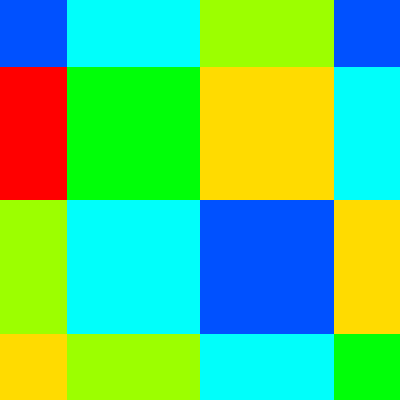
nearest-neighbor interpolation

for the nearest-neighbor interpolation,

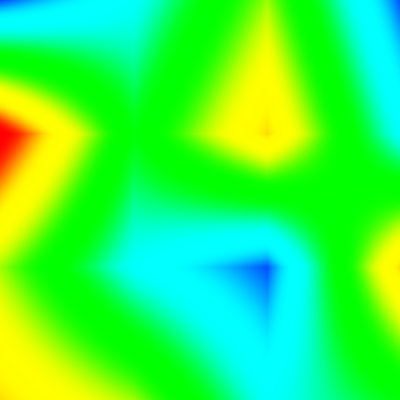
bilinear interpolation

for the bilinear interpolation, and:

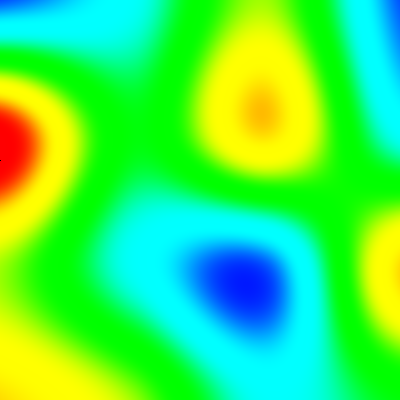
bicubic interpolation

for the bicubic interpolation. I know, the colors are toxic. Of course, with the draw() that I've given above the result should be solid black for each mouse click; to see the interpolations in action, comment the call to interp1().

In the next post I'll show a number of massages performed on interp0().

2012-02-22

For the Right Hand

Useful generic functions are usually the result of composing useful generic functions; the fact that these are easy to write is, however, not an excuse for not having them in a rich prelude. Given a total function for splitting a list at a given point:


let rec split_at n = function
| []            -> [], []
| l when n == 0 -> [], l
| x :: xs       ->
  let l, r = split_at (pred n) xs in
  x :: l, r

and the anamorphism on lists, the basic functional iteration scheme giving the list of results:


let rec unfold f e = match f e with
| None         -> []
| Some (x, e') -> x :: unfold f e'

then splitting a list into chunks just requires some assembly:


let chunks n = unfold (fun l -> match split_at n l with [], [] -> None | p -> Some p)

As another example, suppose we need a Procrustean function fit that truncates a list or pads it with a value to a given length. Given an way to build an infinite list:


let all x = let rec l = x :: l in l

the desired function is just:


let fit n e l = fst (split_at n (l @ all e))

The only good thing about the paucity of Pervasives is that it forces one to practice often this kind of finger exercises. At least they are pretty.